Safeguarding / Prevent

What is Safeguarding?

Safeguarding and promoting the welfare of children is everyone’s responsibility. Everyone who comes into contact with children and their families has a role to play.

In order to fulfil this responsibility effectively, everyone at All Saints’ Catholic Academy ensures the approach is child-centred. This means that All Saints’ Catholic Academy considers, at all times, what is in the best interests of the child.

All Saints’ Catholic Academy recognises that no single practitioner can have a full picture of a child’s needs and circumstances. If children and families are to receive the right help at the right time, everyone who comes into contact with them has a role to play in identifying concerns, sharing information and taking prompt action.

The purpose of safeguarding children is to:

  • Protect them from abuse, maltreatment and exploitation.
  • Prevent anything from harming their health or development.
  • Ensure they can grow up under safe and effective care.
  • Take action to ensure they have the best outcomes in life.


As part of our Safeguarding offer, All Saints’ Catholic Academy and Our Lady of Lourdes Catholic Multi Academy Trust (OLoL CMAT) have a team of people who lead on safeguarding our students, they are our Safeguarding Team.

The Safeguarding Team are also the people who will support with any concerns raised around children’s health, wellbeing and safety, as described above. If you have a concern regarding the wellbeing, health, development, relationships or safety of a child, please use the contact details below.
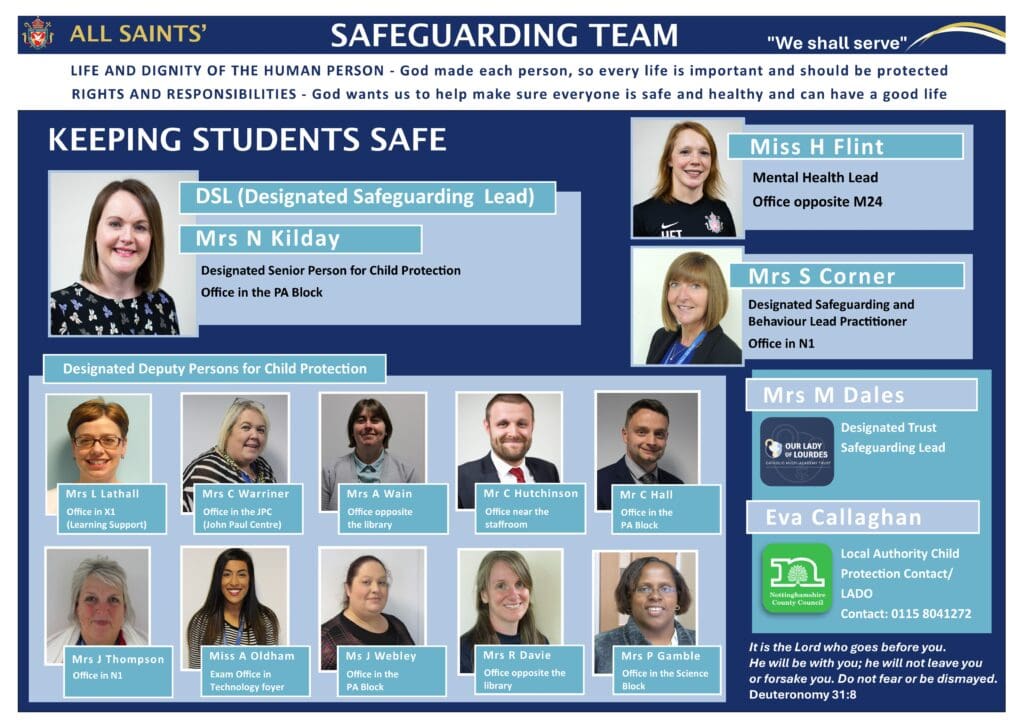
Safeguarding Officers New. Sept 2025
  • Contact our safeguarding team either by telephone (01623) 474700 or via email safeguarding@allsaints.notts.sch.uk
  • Safeguarding hotline (OLoL): Tel: 01158550557 – Available: 9am-3pm (Weekdays)
    Outside of these hours, voicemail will be directed to the safeguarding team.
  • Moira Dales (Trust Safeguarding Lead)
    Tel:07852133114
    Email: m.dales@ololcatholicmat.co.uk
  • Nottinghamshire Multi-Agency Safeguarding Hub (MASH) 

If you think a child is at risk of abuse, please report this via their website. www.nottinghamshire.gov.uk/care/safeguarding/childrens-mash

If you have urgent concerns for a child, or suspect that a child has been abused in any way, please call MASH immediately on 0300 500 80 80 or contact one of the following:

We feel that it is important to support our parents to know how they can protect their children, where to find help and raise concerns if necessary.

As well as skills which are taught within the specific curriculum of Religious Education, PSHE & RSE, please find below contact details for a variety of organisations who support parents and young people if they have any safeguarding, mental health or welfare needs.

  • Parent line 07520 619919: Healthy Family Teams confidential texting service to provide parents and carers advice around feeding, child development, parenting advice and support, emotional health and wellbeing, behaviour difficulties and family health.
  • Health4kids – www.healthforkids.co.uk; this is an NHS site supporting young children and parents.
  • Notts Help Yourself – www.nottshelpyourself.org.uk: this is a site for advice, information and local services available.

All the above websites are for students and their families should they need them.

CAMHS crisis team: (Child and Adolescent Mental Health Services (CAMHS) Crisis Resolution Home Treatment Team) part of the Nottinghamshire Healthcare NHS Foundation Trust. 

This service is for young people experiencing a mental health crisis. This includes young people who:

  • are at risk of immediate and significant self-harm
  • are an immediate and significant risk to others due to their mental health
  • are being considered for admission to a mental health inpatient unit
  • are in acute psychological or emotional distress that is causing them to not be able to go about their daily activities, such as going to school and looking after themselves

Tel: 0115 8542299 or 0115 8440560
EmailCAMHSCrisisTeam@nottshc.nhs.uk

We feel that it is important to support our pupils to know how they can be safe and protected, and to empower them to recognise situations which are unsuitable for them. As well as skills which are taught within the specific curriculum of Religious Education, PSHE & RSE, please find below contact details for a variety of organisations who support young people and their families if they have any safeguarding, mental health or welfare needs.

  • Child line 0800 1111 www.childline.org.uk; Childline is here to help anyone under 19 in the UK with any issue they’re going through. You can talk about anything. Whether it’s something big or small, trained counsellors are on hand to support you.
  • ChatHealth – 07507 329952: this is a confidential texting service for 11 to 19 year olds in Nottinghamshire Healthcare NHS Trust.
  • Kooth – www.kooth.com: Free, safe and anonymous online support for young people
  • Health4teens – www.healthforteens.co.uk– this is an NHS site supporting young people around emotional wellbeing.
  • Health4kids – www.healthforkids.co.uk: this is an NHS site supporting young children and parents.
  • Notts Help Yourself – www.nottshelpyourself.org.uk– this is a site for advice, information and local services available; there is a section for older teens around feelings and sexual health.
  • Young Minds – www.youngminds.org.uk: this organisation support young people to have the best Mental Health

For information about further support please follow this link to the Wellbeing page of our website.  You can also find support and information in our Signposting Booklet.

Culture Statement

At All Saints’ Catholic Academy we have a culture of safeguarding which is as follows:

Our leaders create a culture of vigilance and continuously communicate the importance of safeguarding throughout our school community.

Having a system where concerns can be reported immediately.

  • School uses CPOMs recording system. This is a secure digital platform that enables staff or other members of our organisation (such as volunteers) to record their safeguarding concerns quickly and easily.
  • Actions in response to any concerns are timely and effective.
  • Discussed weekly in the safeguarding team meeting
  • A worry button on the website, plus a team of peer mentors allow students a variety of ways to report concerns.

  Supporting our children.

  • Pupils understand what is unacceptable and how they can disclose this information to us, even if the disclosure isn’t about them.
  • Pupils are regularly reminded of how to disclose (in person or the worry button) and the support that is available to them through external services.
  • Peer mentors are trained as a listening ear and assemblies / tutor time throughout the year are used for reminders
  • Pupils take part in an annual safeguarding survey and other specific surveys throughout the year. Feedback is collated and shared.

Safeguarding Governor

  • Our Safeguarding governor supports all our staff and safeguarding leads.
  • Our safeguarding governor is Alison Fawley. Contact details: fawley.a@allsaints.notts.sch.uk
  • Our safeguarding governor meets with the DSL regularly (termly) to review systems, processes and culture of safeguarding
  • She also ensure that we follow the safer recruitment processes

Working with parents and carers

  • We support our parents and make sure that they are not only aware of what safeguarding is but show them how they can report concerns to us.
  • We ensure that the parents of our pupils know that we are always there to hear their concerns and that their concerns will always be confidential.
  • Our parents receive updates about safeguarding issues including online safety through regular parent bulletins and emails throughout the year.

Continual Professional Development

  • As a school we use Flick safeguarding training every September for all staff and governors.
    • School attends the DSL Networks each term at Trust level.
    • Regular practice in staff meetings to ensure that practical examples and scenarios of safeguarding are discussed to ensure that we keep safeguarding at the forefront of all that we do.
    • All staff understand and recognise risk, as well as potential signs of harm, abuse or other safeguarding concerns
    • The DSL and safeguarding team attend regular and timely training in key areas in order to stay as up to date as possible.

Curriculum

  • Elements of our curriculum enable pupils to recognise and respond to risks to their wellbeing which are successfully designed and delivered, for example, learning about online safety or healthy relationships.
    • We have a clear RSE programme in school.Environment
  • Our environment is effectively designed to safeguard students – this includes physical aspects of the environment such as CCTV cameras, secure gates, ID access to specific rooms, windowed doors into rooms, sign in/out inventory.
  • We have more cultural or behavioural elements, such as zero tolerance of discriminatory language and behaviour which is met with consequences to deter repeat offences
  • Catholic Social Teaching Principles are linked to safeguarding

Contextual Safeguarding

Each School has a separate contextual area of risk and mitigation.

Online abuse/E-Safety

  • Robust filtering and monitoring within school to prevent access to any harmful online content and notify Safeguarding of any concerning key strokes/searches
    • Lessons dedicated to online safety through IT and Personal development Relationships- domestic abuse, sexual assault/violence, harmful sexual behaviour
    • Education around healthy relationships through high quality RE and Personal development lessons
    • Student assemblies and participation in Safer Internet Week

Child on Child

  • School ensures a safe and supportive environment
  • School assesses the risks that young people may be exposed to outside their school or college, as well as inside it by parent and pupil voice, liaising with local agencies including the police.
  • There is a safe space in school for young people and/or families to talk to school about experiences. Peer mentors also offer a listening ear.
  • School conducts ‘safety mapping’ and student voice with pupils, where school helps them to identify safe adults that they could turn to when they feel vulnerable outside their school or college
  • Response to EPAS notifications

Family issues

  • School ensures a safe and supportive environment
  • There is a safe space in school for young people to talk to school about experiences. Peer mentors also offer a listening ear.
  • Response to Encompass notifications
  • Support from the John Paul Centre